


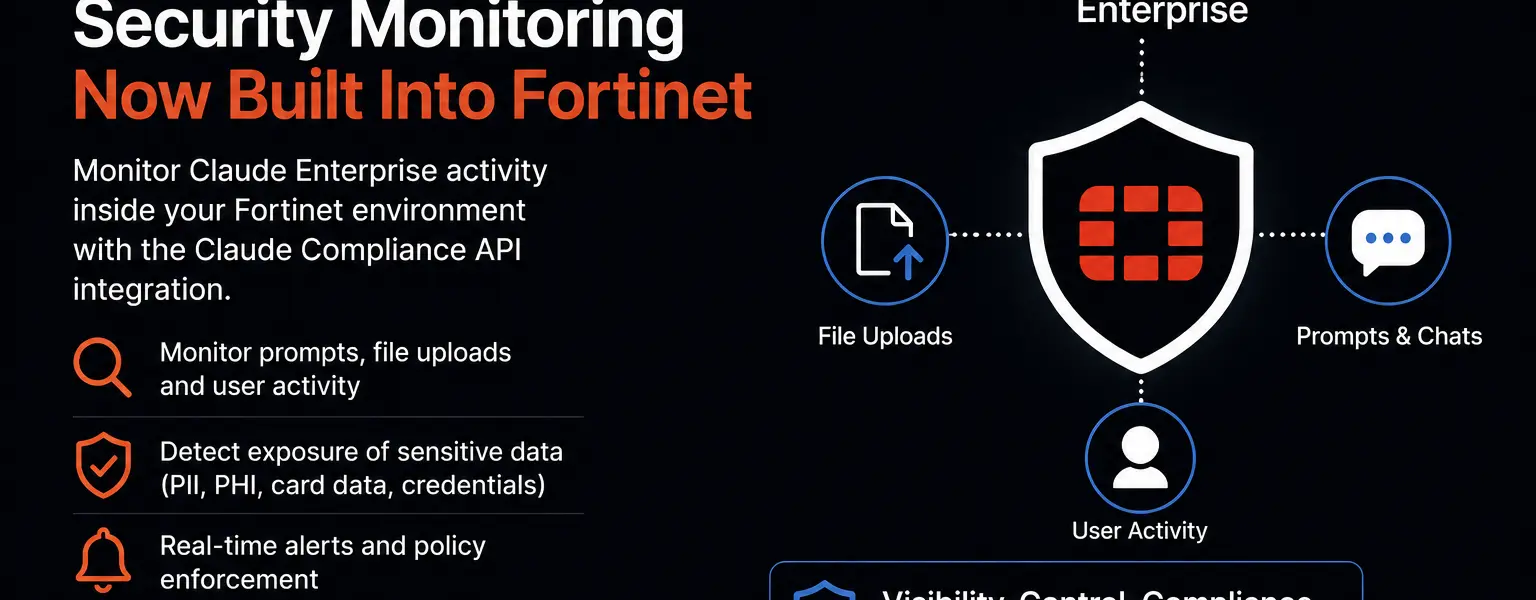
Claude enterprise security monitoring is now a built-in capability for organizations running Fortinet infrastructure. Anthropic has released a Claude Compliance API with integrations from 28 security platforms, including Fortinet’s data security posture management solution, giving IT and security teams structured visibility into how employees are using Claude Enterprise inside their existing security environment.
If your organization is running Fortinet and employees are using Claude, this is worth understanding now.
The Claude Compliance API gives enterprise security teams programmatic access to security-relevant data about how Claude is being used across their organization. Fortinet’s data security posture management platform has built an integration on top of this API, making claude enterprise security monitoring a practical, deployable capability rather than a future roadmap item.
In concrete terms, your Fortinet environment can now ingest and analyze user interactions within Claude Enterprise. That includes the prompts employees are submitting, the files they are uploading, and any potential exposure of sensitive data categories including personally identifiable information, protected health information, cardholder data, and authentication credentials.
The integration provides visibility, alerting, and auditability for AI usage inside dashboards and workflows your security team already operates. There is no new vendor relationship to establish, no separate console to learn, and no additional agent to deploy on endpoints.
For organizations already running the Fortinet Security Fabric, this means AI governance does not have to be a separate program. It becomes part of what your team already does every day.
Claude Enterprise is Anthropic’s AI platform built for large organizations where security, compliance, and administrative oversight are requirements rather than optional features. Unlike personal or team accounts, Claude Enterprise gives organizations centralized control over access, policy, and data handling.
This distinction matters because claude enterprise security monitoring through the Compliance API is only available for Claude Enterprise and Claude Platform deployments. If your organization has rolled out Claude through an enterprise agreement, this integration applies directly. Personal, Pro, and Team plan accounts are not covered.
The data available through the Compliance API for Claude Enterprise includes conversation content such as chats, uploaded files, and project activity, as well as activity feed events covering user logins, administrative actions, and configuration changes. This is a meaningful audit surface that did not previously flow into security tooling in a structured way.
The problem it solves is real. Employees interact with AI platforms differently than they interact with traditional software. They paste content directly into prompts. They upload internal documents to get faster answers. They generate new content at scale. Each of those interactions can expose sensitive organizational data, and until now most security teams had no structured way to see it.
Most organizations dealing with AI governance today are not doing so because they planned a controlled rollout. They are doing so because employees started using AI tools before IT had a policy in place, and security teams are now catching up.
Shadow AI, meaning the use of AI platforms outside sanctioned organizational channels, is already present in most mid-market and enterprise environments. A developer pastes proprietary source code into a chat window to debug a function. A finance employee uploads a spreadsheet with client data to get a formula written faster. A sales manager shares a confidential proposal draft to get it edited quickly. None of these actions go through a security review, and until recently none of them were visible to security teams in any meaningful way.
Claude enterprise security monitoring through the Fortinet integration addresses this gap for organizations that have standardized on Claude Enterprise. It brings AI activity into the same detection and response workflows used for email, file transfers, and web traffic. Alerts, audit logs, and policy enforcement all operate within the environment your team already manages.
For Canadian organizations with PIPEDA obligations around personal information handling, the auditability layer this creates is directly relevant. If personal information is being submitted to an AI platform by employees, organizations have a reasonable obligation to know about it and to have controls in place. This integration provides both the visibility and the audit trail to support that position.
One of the more practical aspects of this integration is that it requires no new tooling. Fortinet’s data security posture management platform is already part of the Fortinet Security Fabric that many organizations use to consolidate visibility across network, endpoint, and cloud environments.
Adding Claude Enterprise activity into that fabric means your security team can apply consistent policy across AI interactions the same way they apply policy to every other data flow in the environment. If you are running FortiManager for centralized policy management, claude enterprise security monitoring becomes another governed policy domain inside FortiManager, not a standalone program with its own reporting chain.
Setup follows a straightforward process. You enable the Compliance API inside your Claude Enterprise organization settings, then connect your instance to the Fortinet platform using Fortinet’s published setup guide. From that point, Claude activity flows into your existing Fortinet dashboards and alerting workflows automatically.
DataCenter360 works with Canadian organizations running Fortinet infrastructure to configure, manage, and optimize their security environments. If you want to understand what this integration looks like in your specific Fortinet setup, that is the kind of conversation we have with clients every week. Learn more about our managed security services or reach us directly.
If your organization is running Claude Enterprise and has not yet looked at the Compliance API, this is a good time to start. The Fortinet integration is available now and the configuration documentation is published directly by Fortinet.
If your organization has not yet moved to Claude Enterprise but employees are using AI tools, that is a related conversation worth having before an incident forces it. Standardizing on a governed deployment is the first step toward real claude enterprise security monitoring, and it is considerably easier to implement proactively than reactively.
For security and compliance teams, the audit trail this integration creates is meaningful. It gives you documentation of AI usage, evidence of active monitoring, and a basis for policy enforcement. For organizations working toward SOC 2 compliance or managing PIPEDA obligations, that documentation has direct value in assessments and audits.
The Fortinet integration with the Claude Compliance API captures user interactions within Claude Enterprise including prompts submitted by employees and files uploaded to the platform. It detects potential exposure of sensitive data categories including personally identifiable information, protected health information, cardholder data, and authentication credentials. Activity feed events covering logins, administrative actions, and configuration changes are also captured and fed into your Fortinet environment.
No. Claude enterprise security monitoring through the Compliance API is available for Claude Enterprise and Claude Platform deployments only. Personal, Pro, and Team plan accounts are not supported by the API. If your organization is evaluating Claude Enterprise and wants to understand how Fortinet integration would work in your environment, that evaluation is worth doing before you finalize your licensing decision.
No. The integration is designed to work within your existing Fortinet environment. It pulls Claude Enterprise activity into the dashboards and workflows you already use. You enable the Compliance API in your Claude Enterprise organization settings, connect your instance to Fortinet’s platform using the published setup guide, and activity begins flowing automatically. No new platform, no new vendor, and no replacement of existing infrastructure is required.
Yes. PIPEDA requires organizations to take reasonable steps to protect personal information under their control. Employees submitting personal information to an AI platform is a real and current exposure for most organizations. The Fortinet integration provides the auditability and alerting that supports a defensible position under PIPEDA. It does not replace a broader privacy program, but it closes a visibility gap that most organizations currently have and have not yet addressed.
If your organization runs Fortinet and is working through AI governance in 2026, DataCenter360 can help you understand what claude enterprise security monitoring looks like in your specific environment. We are a Fortinet Select Partner and MSSP based in Toronto, working with Canadian businesses across the country.
Reach us at datacenter360.ca/contact-us or email us at [email protected].