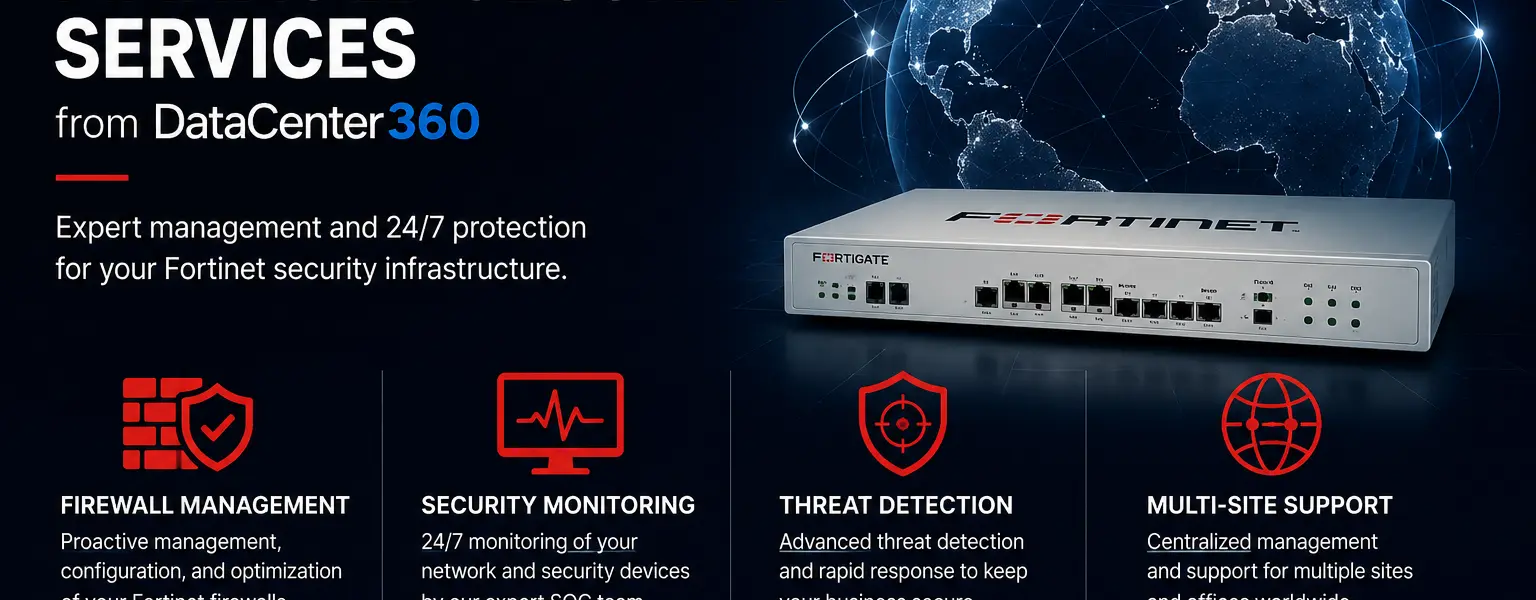
Fortinet managed security services give organizations access to continuous firewall management, security monitoring, and Fortinet expertise without the cost and complexity of building that capability internally. For businesses already running Fortinet infrastructure, or considering it, working with a Fortinet MSSP means your security environment is actively managed by people who know the platform in depth, not reviewed once a quarter or left to run on its original configuration indefinitely.
This post explains what Fortinet managed security services actually involve, who they are designed for, and what to look for when evaluating a provider.
The term managed security services covers a wide range of activities depending on the provider. In a Fortinet context, the core of a well-structured managed service typically includes the following.
Firewall management covers the ongoing configuration, optimization, and monitoring of FortiGate firewalls. This includes policy management, firmware updates, FortiGuard subscription maintenance, and responding to configuration changes as the organization’s network evolves. A firewall that was correctly configured at deployment will drift from its optimal state over time without active management. New applications are added, users change, network segments shift, and the threat landscape changes continuously. Active firewall management ensures the FortiGate is always enforcing the right policy against current threats.
Security monitoring provides continuous visibility into security events across the network. On a FortiGate environment this means reviewing logs and alerts generated by IPS, application control, antivirus, DNS filtering, and other active services. Without someone reviewing that data, alerts go unseen and suspicious activity goes uninvestigated. A managed service closes that gap by ensuring events are reviewed, triaged, and escalated when warranted.
Threat detection and investigation goes a step further. Rather than simply collecting logs, a Fortinet MSSP actively looks for indicators of compromise, unusual traffic patterns, and policy violations that might not trigger an obvious alert on their own. For organizations without a dedicated security operations function internally, this is the capability they are most likely to lack and least likely to realize they are missing.
Security management covers the broader operational work: firmware patching, FortiGuard license renewals, best practice reviews, and keeping security policies aligned with the organization’s actual risk posture. This is the unglamorous but essential maintenance that prevents the slow erosion of a security environment that looked good on day one.
Multi-site support extends all of the above across organizations operating multiple offices, branches, or locations. Managing security consistently across distributed environments is significantly more complex than managing a single site, and it is an area where organizations with internal IT teams often struggle most.
Fortinet managed security services are not exclusively for organizations without internal IT resources. The businesses that benefit most tend to fall into a few recognizable categories.
Small and mid-sized businesses that have deployed FortiGate firewalls but do not have a dedicated network security engineer on staff are the most obvious fit. The hardware is in place and the licensing is paid for, but the environment is not being actively managed. FortiGuard subscriptions may be approaching expiry unnoticed. Firmware is running versions behind. Security policies reflect the network as it was configured two years ago. A managed service corrects all of this and keeps it correct going forward.
Internal IT teams that have general competency but not deep Fortinet specialization also benefit significantly. The Fortinet Security Fabric is a capable and complex platform. Getting the most out of FortiGate, FortiAnalyzer, FortiClient EMS, and related products requires experience that takes time to build. An MSSP with dedicated Fortinet expertise supplements the internal team rather than replacing it, covering the security operations work while the internal team focuses on infrastructure, users, and business priorities.
Multi-location organizations face a specific challenge: maintaining consistent security policy and visibility across sites that may have different network architectures, different IT contacts, and different histories of configuration changes. Fortinet managed security services that explicitly support multi-site environments can standardize security operations across the entire organization, not just the head office.
Organizations already using Fortinet solutions are the natural fit for a Fortinet-focused MSSP. The expertise is directly applicable, the tooling is already in place, and the managed service can start delivering value immediately rather than spending time getting familiar with an unfamiliar platform.
Organizations sometimes delay engaging a managed service because the cost feels avoidable. The FortiGate is running, nobody has complained, and the license renewal is handled when it comes up. That framing underestimates the actual cost of an unmanaged security environment.
An unmanaged FortiGate running outdated firmware is exposed to vulnerabilities that Fortinet has already patched. FortiGuard threat intelligence subscriptions that have lapsed mean the firewall is no longer receiving updated signatures, so threats that emerged after the lapse pass through uninspected. Security policies that have not been reviewed accumulate unnecessary rules, overly permissive access, and gaps created by network changes that nobody thought to reflect in firewall policy.
None of this is visible until something goes wrong. By then the cost is not a managed service retainer. It is incident response, potential data exposure, business disruption, and the reputational and regulatory consequences that follow. For organizations with compliance obligations under PIPEDA or equivalent frameworks in their jurisdiction, demonstrating that appropriate safeguards were actively maintained is part of the compliance requirement itself. An unmanaged firewall is difficult to defend in that context.
Not every MSSP that claims Fortinet expertise has it in depth. When evaluating providers, a few criteria separate genuine Fortinet specialists from generalists who happen to support the platform.
Fortinet partner status is the baseline credential. A Fortinet Select Partner designation indicates that the organization has met Fortinet’s requirements for technical competency and active engagement with the vendor program. It is a verifiable credential, not a self-applied label, and it means the provider has access to Fortinet technical resources, training, and support that general IT firms do not.
Specific MSSP designation from Fortinet indicates that the provider is recognized not just as a reseller but as a managed services operator. This distinction matters because the service delivery model for managed security is different from the transactional model of selling hardware and licensing. A Fortinet-designated MSSP has demonstrated the operational capability to deliver ongoing managed services on the Fortinet platform.
Experience with multi-location environments matters for any organization operating more than one site. Ask specifically how the provider manages policy consistency across locations, how they handle sites in different time zones or jurisdictions, and what their process is for onboarding a new location into an existing managed environment.
Clear communication and responsive support are often underweighted in technical evaluations and overweighted in actual client satisfaction. A managed security service is an ongoing relationship. The technical capability matters, but so does the ability to explain what is happening in plain language, respond to questions promptly, and escalate issues in a way the client can understand and act on.
DataCenter360 is a Fortinet Select Partner and MSSP supporting organizations worldwide with Fortinet managed security services. The team provides security monitoring, firewall management, threat detection, and security guidance for businesses running Fortinet environments, whether that is a single FortiGate at a single location or a distributed deployment across multiple sites.
Services include ongoing firewall configuration and policy management, continuous monitoring of security events, firmware and FortiGuard subscription management, multi-site support, and practical security guidance to improve overall security posture. The focus is on organizations that want their Fortinet environment actively managed by people who know the platform, rather than checked in on occasionally by a generalist IT team.
If your organization is running Fortinet infrastructure and wants to understand what a managed service engagement would look like, reach out at [email protected] or visit the DataCenter360 managed security services page to learn more. You can also start a conversation directly at datacenter360.ca/contact-us.
A Fortinet reseller sells Fortinet hardware, licensing, and renewals. A Fortinet MSSP provides ongoing managed services on top of that: monitoring your environment, managing your firewall configuration, maintaining your licensing, and actively working to keep your security posture current. Many MSSPs also sell and source Fortinet products, but the managed service component is what distinguishes them from a transactional reseller relationship.
No. Fortinet managed security services are designed to work with your existing Fortinet infrastructure. If you already have FortiGate firewalls deployed, a managed service can be layered on top of your current environment. The onboarding process typically involves a review of your current configuration, licensing status, and security posture, followed by an agreed scope of ongoing management and monitoring activities.
A Fortinet MSSP with genuine multi-site experience manages security policy and monitoring centrally across all locations, using tools like FortiManager for centralized policy deployment and FortiAnalyzer for consolidated log collection and reporting. This means security policy is consistent across sites, events at any location are visible from a single pane, and changes can be deployed across the environment without needing to log into each device individually.
Yes, and arguably more so than for large enterprises. Large organizations typically have dedicated security staff and the budget to build internal capability. Small and mid-sized businesses usually do not, which means their Fortinet environment runs without active management until something breaks or expires. A managed service gives a smaller organization access to the same depth of Fortinet expertise and ongoing security operations that a large enterprise would have internally, at a fraction of the cost of hiring for it.
DataCenter360 is a Fortinet Select Partner and MSSP supporting organizations worldwide. Whether you are evaluating managed security services for the first time, looking for Fortinet expertise to support your internal team, or managing security across multiple locations, the team can help. Contact us at [email protected] or visit datacenter360.ca/contact-us to speak with a specialist.
